
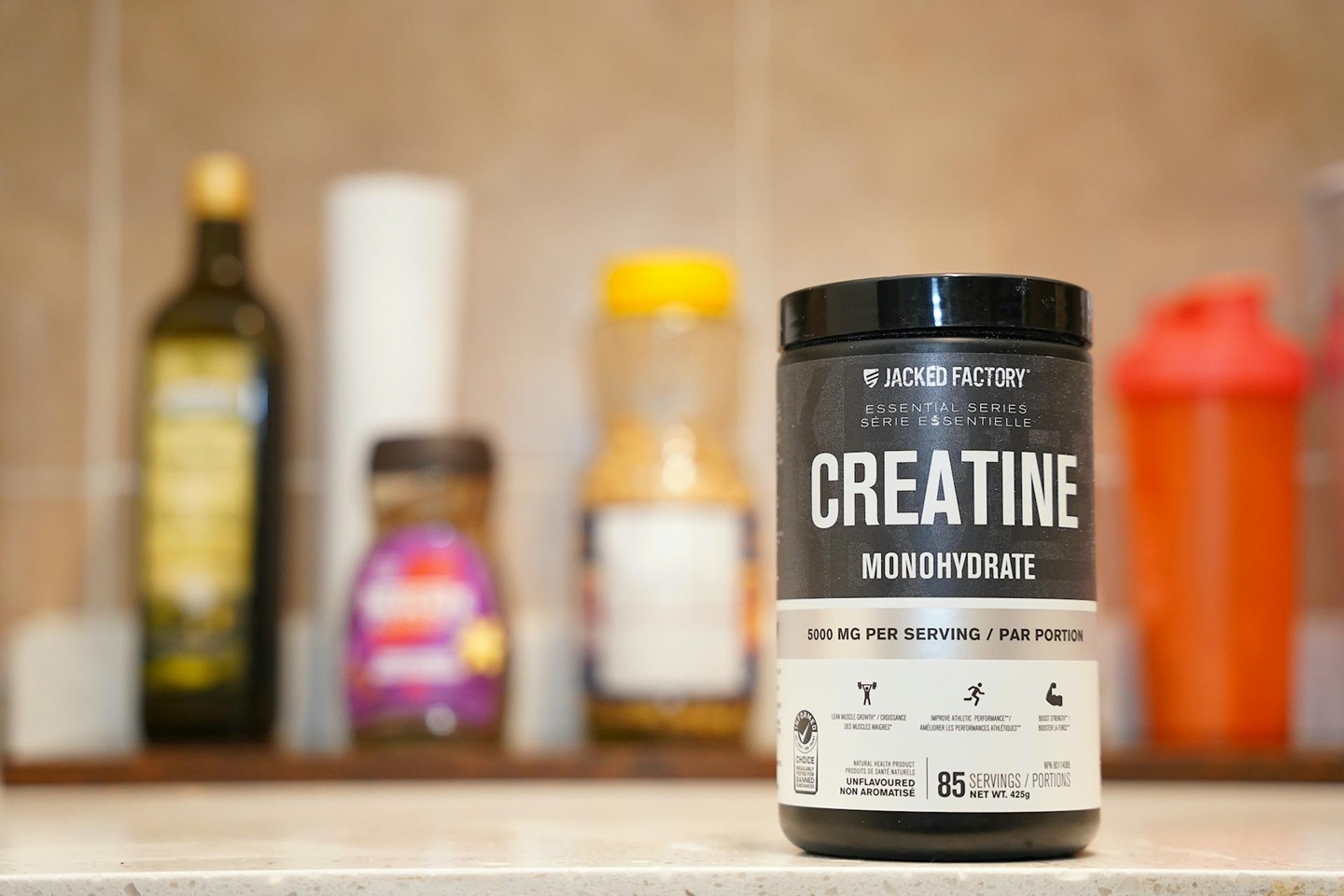
Creatine is a naturally occurring nitrogenous compound synthesized primarily in the liver, kidneys, and pancreas from the amino acids glycine, arginine, and methionine. Approximately 95% of the body’s total creatine is found in skeletal muscle, mainly in the form of phosphocreatine.
Creatine plays a key role in energy production during short-term, high-intensity physical activity—particularly in strength sports, sprinting, and interval training.
The body naturally produces about 1–2 grams of creatine per day, and an additional amount (about 1–2 grams) can be obtained through diet, mainly by eating meat and fish. However, for people who train intensively, especially those engaged in short-duration, high-intensity exercise, the body’s natural supply of creatine may be insufficient.
During intense exercise, muscles consume ATP (adenosine triphosphate)—the cell’s primary “fuel.” However, ATP stores are very limited and last only for a few seconds of maximum effort. This is where phosphocreatine plays a key role.
Phosphocreatine donates a phosphate group to ADP, enabling the rapid resynthesis of ATP.
As a result:
- The ability to perform intense physical activity increases,
- Muscle strength and power improve,
- It is possible to do more repetitions,
- Recovery between sets is improving,
- In the long term, this translates to greater gains in strength and muscle mass.
This is the most popular and best-studied form of creatine. It consists of a creatine molecule bound to a water molecule, which increases its stability. Creatine monohydrate is characterized by:
- High effectiveness confirmed by numerous studies
- Affordable
- Good bioavailability
- The ability to bind water in muscle cells
The International Society of Sports Nutrition (ISSN) recognizes creatine monohydrate as the most effective ergogenic supplement currently available to athletes.
- Increase strength by 5–15%,
- Increase lean body mass,
- Improve anaerobic capacity,
- Speed up post-workout recovery.
In addition, the monohydrate has the best-documented safety profile, both for short-term and long-term use.
- Many scientific studies,
- High effectiveness,
- Low price,
- Safety,
- Proven effectiveness.
Some people may experience mild stomach upset, such as diarrhea. It may cause intracellular water retention,
It is worth noting, however, that most problems stem from taking high doses of the supplement or using a low-quality product rather than from the monohydrate itself.
Liposomes are microscopic vesicles composed of phospholipids similar to those found in human cell membranes. Liposomal technology involves “encapsulating” an active substance (e.g., creatine) within a lipid shell, which theoretically:
- Protect the substance from degradation,
- Increase absorption,
- Improve transport across cell membranes.
This technology is indeed used in the pharmaceutical industry, particularly for certain drugs with low bioavailability.
Manufacturers of liposomal creatine most often claim:
- Better absorption,
- Faster muscle recovery,
- Lower doses are needed to achieve the desired effect,
- No water retention,
- Better stomach tolerance.
There is a lack of high-quality comparative studies—currently, there is no strong scientific evidence showing that liposomal creatine works better than monohydrate. Most studies on creatine have been conducted using monohydrate, and many new forms of creatine are based more on marketing than on physiological advantages. The ISSN clearly emphasizes that creatine monohydrate remains the most well-studied and most effective form of creatine.
- The number of studies is very limited,
- These are often studies conducted by manufacturers,
- No significant increase in strength or muscle mass was observed compared to monohydrate.
Bioavailability: Theoretically higher in liposomal creatine.
Ergogenic effects (strength, muscle mass, etc.): Documented only for creatine monohydrate.
Stability: Better in creatine monohydrate
Price: Creatine monohydrate - low / Liposomal creatine - high
Safety: Very well researched – Creatine monohydrate / Limited data – Liposomal creatine
The supplement market very often uses slogans such as:
“The new generation of creatine,”
“Maximum bioavailability,”
“Nanotechnology,”
“Liposomal delivery system”,
“Better absorption.”
A higher price does not automatically mean that creatine and other supplements are more effective. Many new forms of creatine do not undergo the same rigorous testing as monohydrate. Marketing often outpaces science and is not guided by scientific research.
For most people, there is currently no strong evidence that liposomal creatine provides better training results than monohydrate. However, the cost of liposomal creatine supplementation is significantly higher. An exception may be people with gastrointestinal issues who have difficulty tolerating standard monohydrate or who prefer liquid or specialized forms of supplementation. However, it is important to note that even in these cases, the superiority of liposomal creatine has not been unequivocally confirmed by science.
Is liposomal creatine better than monohydrate? Based on the current scientific literature— NO!
Creatine monohydrate remains the most thoroughly researched, most effective, safest, and most cost-effective form of creatine available on the market.
Liposomal creatine has an interesting technological concept, but there is a lack of strong scientific evidence; no clear ergogenic advantage has been demonstrated, and its high price is currently not well justified.
That's why, for most people, classic creatine monohydrate remains the best choice!
https://o-lekach.pl/kreatyna-dzialanie-i-zalecenia/
https://dietetycy.org.pl/jak-dziala-kreatyna/
https://link.springer.com/article/10.1186/1550-2783-4-6?utm
https://pmc.ncbi.nlm.nih.gov/articles/PMC5469049/?utm
Prepared by: Wiktoria Kubicka

.jpg)