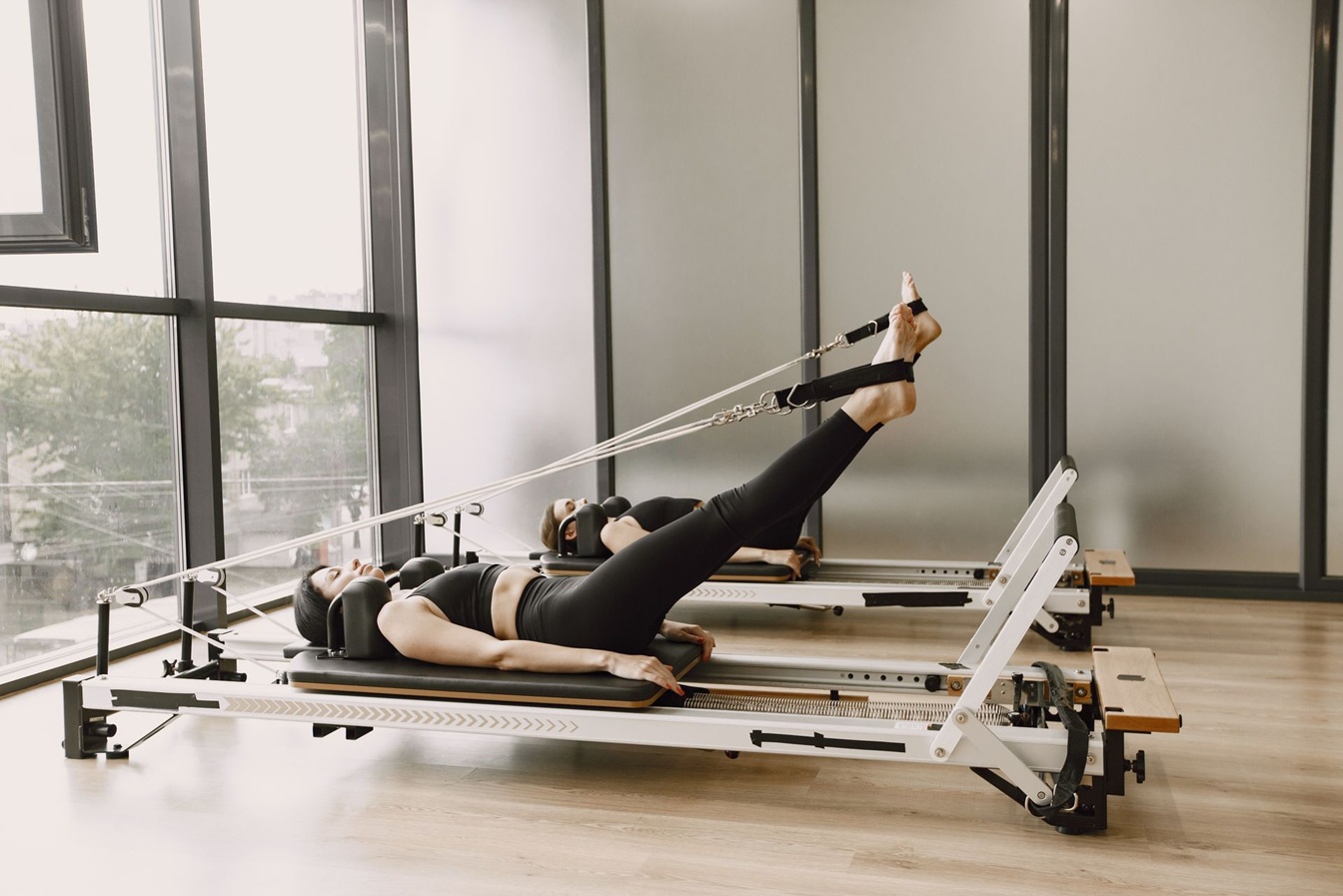
Let's start with the most common myths:
- “Pilates is only for women.” No. It’s a form of exercise, not a discipline specific to a particular gender.
- “It’s just stretching.” Not exactly. Pilates combines strength training with exercises that focus on stability, mobility, balance, breathing, and movement control.
- “You can’t build strength with Pilates.” You can develop muscle strength and endurance, especially for beginners. However, this doesn’t mean that
Pilates can replace traditional strength training if our goal is to maximize strength or muscle mass.
- “It will be too easy for an active person.” That depends on your fitness level. Pilates can be practiced in both a very gentle form and one that requires a great deal of strength and control.
- A more powerful core
Pilates strongly engages the muscles responsible for stabilizing the torso. Studies show that regular training can improve, among other things, abdominal muscle endurance. And this isn’t just about a “flat stomach.” A strong core is primarily meant to help us better control our bodies during movement.
- Greater mobility and better traffic control
Pilates requires precision. It’s not just about performing the exercises, but also about how we perform them. Regular practice can improve range of motion, balance, and postural control. Reviews of studies also point to the beneficial effects of Pilates on selected postural parameters.
- It may help with back pain
This is one of the most thoroughly researched areas. Meta-analyses indicate that Pilates may reduce symptoms associated with lower back pain compared to no exercise. However, this does not mean that Pilates is a cure for all back pain. For chronic or worsening symptoms, exercises should be appropriately selected and, if necessary, discussed with a specialist.
- Improves balance
This is especially important as we age. Studies show that Pilates can improve balance in older adults and also support their physical fitness and quality of life.
This is where Pilates really gets interesting.
- For runners
Running involves thousands of repetitive steps. Each one requires proper control of the torso, pelvis, and limbs. In a study conducted on trained runners, 12 weeks of Pilates training improved their 5-km performance and altered the metabolic cost of running. Study on runners – PubMed
Of course, this doesn't mean that Pilates can replace running. However, it can be
a valuable complement to it.
- For someone who does strength training
Pilates can help improve mobility, stability, and body control. This is important because strong muscles don't always mean good control over movement.
- CrossFit, HYROX, and team sports
In these disciplines, it’s not just strength and endurance that matter, but also the ability to control one’s body during dynamic movements. Pilates can therefore serve as a complementary practice, particularly in the areas of stability, mobility, and coordination.
This is increasingly becoming the modern approach to training. We don’t have to choose between the gym OR Pilates OR running. We can combine different forms of activity, because each one develops slightly different aspects of fitness. Strength training builds strength. Cardio improves cardiovascular endurance. Pilates can support movement control, stability, mobility, and balance. These aren’t competing forms of activity. They’re pieces of a larger puzzle.
For just about anyone—but especially for:
- people just starting out on their fitness journey,
- people who lead a sedentary lifestyle,
- people who want to work on their mobility and movement control,
- runners and other athletes,
- older adults,
- people returning to physical activity after an injury—after selecting appropriate exercises and consulting with a specialist.
You don’t have to start with daily workouts. 1–2 Pilates sessions per week, lasting 30–60 minutes each, can be a good complement to an active lifestyle. Studies have often involved 2–3 sessions per week for several to over a dozen weeks.
Pilates isn’t a magic workout that can replace the gym, running, or sports training. And that’s exactly why it’s worth looking at it differently—not as a substitute, but as a complement. In an age when we spend many hours sitting and are increasingly engaging in demanding workouts, the ability to consciously control your own body becomes incredibly valuable. Because fitness isn’t just about how much you can lift or how fast you can run. It’s also about how well you can move. And perhaps that’s exactly why Pilates has moved beyond being just a “trend” to become one of the most interesting tools in modern fitness.
1. https://pubmed.ncbi.nlm.nih.gov/26004043/
2. https://pubmed.ncbi.nlm.nih.gov/35323204/
3. https://pubmed.ncbi.nlm.nih.gov/37632387/
4. https://pubmed.ncbi.nlm.nih.gov/39372244/
5. https://pubmed.ncbi.nlm.nih.gov/26004043/
Prepared by: Justyna Kurasz
.jpg)
.jpg)


